
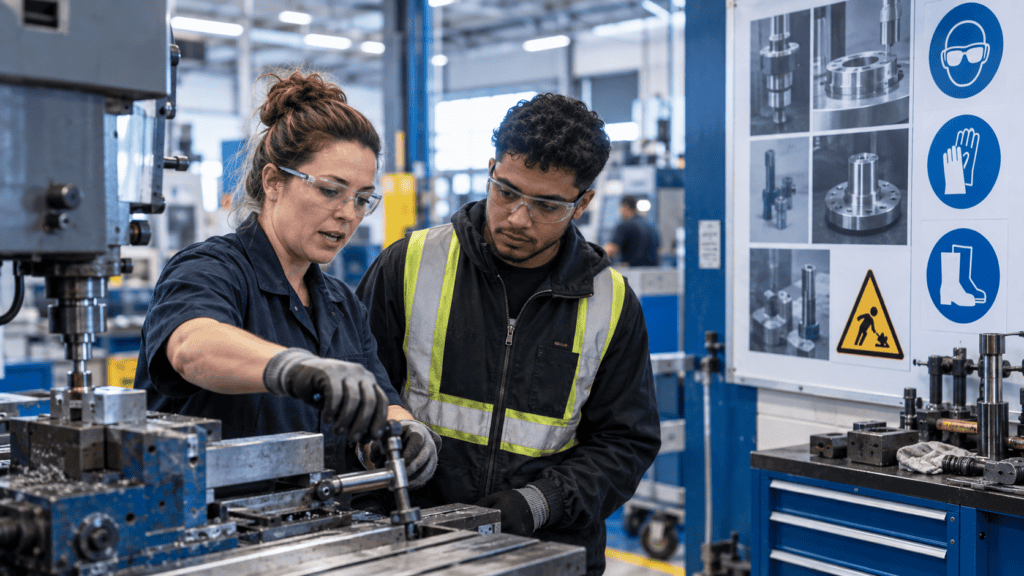
More and more Quebec plants rely on workers from abroad to fill their jobs. They are often motivated and skilled employees. But when training is delivered too fast, in rapid French and with shop-floor vocabulary, part of the message gets lost. And in a plant, a lost message can become an accident.
Key takeaways
- The employer must make sure every worker truly understands the risks and instructions: a signature on a sheet doesn’t prove understanding.
- In Quebec, training documents for staff must be available in French; translations and visuals are added, they don’t replace it.
- The “show me” method, photos of your real machines and a visual shop-floor glossary work better than long texts.
In this article
Understanding is not signing
Quebec’s Act respecting occupational health and safety (section 51) requires the employer to adequately inform workers of the risks of their work and to provide appropriate training, coaching and supervision. The key word is “adequately”: training the worker didn’t understand doesn’t meet that obligation.
Yet several traps make it look like a message got through when it didn’t:
- The polite “yes”: in many cultures, admitting you didn’t understand is embarrassing, especially in front of a supervisor.
- Shop-floor vocabulary: local expressions, anglicisms and machine nicknames aren’t taught in any French course.
- Speed: an instruction given quickly, in the noise, at the end of a shift, is hard to follow even in your mother tongue.
What the law requires for language
In Quebec, the Charter of the French language (section 41) requires training documents produced for staff to be available in French. Your procedures, sheets and courses must therefore exist in French.
Nothing prevents you, however, from adding translations, subtitles in other languages or oral explanations in the worker’s language to make sure safety instructions are understood. The French version remains the reference; other languages are a complement.
To help your employees improve their French, Francisation Québec offers free French courses to eligible companies, including in the workplace during paid hours. It’s an investment that makes every later training easier.
Visuals that work
A well-chosen image crosses language barriers. Four types of visuals work well in plants:
Photos of your machines
Not generic images: your machine, with arrows and numbers on each step.
Workers recognize what they’ll see at the workstation.
Pictograms
WHMIS and safety pictograms are already understood worldwide.
Use them everywhere, consistently.
Colour codes
Red for stop and danger, green for compliant, yellow for caution.
One simple rule, applied everywhere in the plant.
Short videos
Show the action rather than describe it, with French subtitles and other languages if needed.
Workers can replay it as often as they need.
The “show me” method
The best way to check understanding isn’t to ask “did you understand?”, it’s to say “show me”. Here’s the sequence:
Explain simply
Short sentences, one word for each object (always the same one), and no local expressions.
Demonstrate
Do the task in front of the worker, slowly, naming each step.
Have them do it
The worker repeats the task while the trainer watches, stepping in only if there’s danger.
Have them explain it back
The worker explains in their own words, or by showing, why each step matters, especially the safety steps.
Validate and document
Once the task is done right, record it in the training register with the date and the trainer’s name.
Everyday communication
Training doesn’t stop on day one. A few simple habits make a big difference:
✅ Do
- Speak slowly and clearly, without shouting
- Always use the same word for the same thing
- Ask open questions: “What do you do if the machine jams?”
- Pair them with a patient mentor
- Welcome questions
❌ Avoid
- Asking “did you understand?” and settling for a yes
- Local slang and swearing
- A mentor who translates without the instruction being validated
- Long written instructions only
- Mocking accents or mistakes
A good mentor makes all the difference. See how to structure mentoring in our article on structured mentorship.
Build a visual shop-floor glossary
A simple, very effective tool: a glossary of 30 to 50 essential words from your plant. Each word comes with a photo and, if needed, its translation into your team’s languages. Machine names, tools, parts, protective equipment and key instructions such as “stop”, “lock out” or “danger”.
A safety instruction is only passed on when the worker can show it, not when they’ve signed for it.
Use this glossary from a new employee’s very first day (see our tips on onboarding new employees). Post it in the break room too, so everyone can check it. It works well alongside WHMIS training. And if you add short videos at the workstation, every employee can learn at their own pace.
Frequently asked questions
Can health and safety training be given in the worker’s language?
Yes, as a complement, to make sure they understand the risks. Training documents must, however, also exist in French, in line with the Charter of the French language.
How do I check that a worker really understood?
Ask them to show the task and explain the safety steps, rather than answer yes or no. Use scenario questions: “What do you do if…?”
Where can I find French courses for my employees?
Francisation Québec offers free French courses to eligible companies, including in the workplace. Contact them directly to learn which options are available to your company.
Can online training help?
Yes. Subtitled videos let workers review content at their own pace, as often as needed, and a platform keeps proof that the training was completed and passed.
Welcoming workers from around the world? Witeach builds visual training, filmed on your machines and subtitled, so every employee understands instructions the first time, with training records included.
