
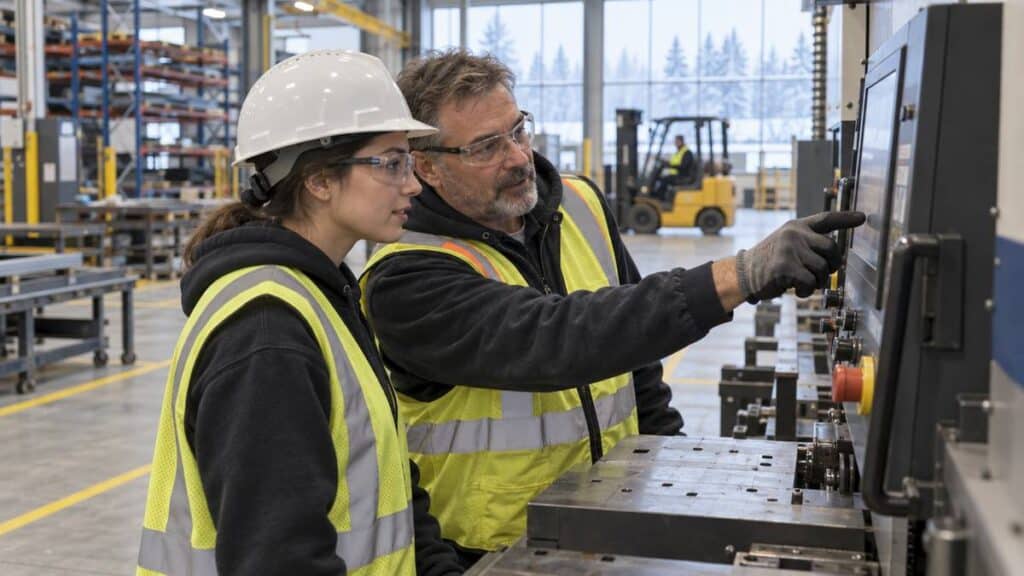
Monday, 7 a.m. Your new hire walks in. They don’t know anyone. They don’t know where the exits are. They don’t know your machines. What happens over the next five days matters a lot. For their safety. And for their decision to stay. Here is a simple, day-by-day plan.
Key takeaways
- Quebec law (AOHS, s. 51) requires you to inform, train and supervise every worker.
- A planned first week replaces “just follow Gaétan, he’ll show you.”
- Keep written proof of each step: who, what, when, and who checked.
In this article
What the law requires
Onboarding isn’t just good manners. It’s a legal obligation. Three texts matter:
Train and supervise
Inform workers of the risks of their work. Provide appropriate training, practice and supervision.
Right to refuse
Any worker may refuse work if they have reasonable grounds to believe it is dangerous.
Hazardous products
The training program must be adapted to the workers, the workplace and the products on site.
These rules come from the Act respecting occupational health and safety (AOHS) and the Regulation respecting hazardous products information. The CNESST adds a useful reminder on its onboarding page (in French): all onboarding, training and supervision hours must be paid.
Before day 1: get ready
The CNESST recommends defining a new hire’s tasks before hiring. Those tasks determine the training they need. Do these four things before they arrive:
List their tasks
Write down what they will do, station by station. Flag the high-risk tasks.
Pick a mentor
An experienced, available employee who knows how to teach. See why you should train your mentors.
Get their gear ready
Protective equipment in their size, locker, access, schedule.
Prepare online modules
Anything you repeat with every hire can be delivered as short videos.
Day 1: welcome and safety
Day one is not about production. It’s about welcome and safety. Your new hire should go home knowing what to do if something goes wrong.
- A plant tour, including emergency exits and the assembly point.
- Your health and safety contacts. The law requires you to designate them and post their names (AOHS, s. 51 (2)).
- Protective equipment required at each station, and how to wear it.
- How to report a hazard or an incident, even a minor one.
- The right to refuse. Say it plainly: they can refuse dangerous work.
Keep the day light. Too much information means nothing sticks. We cover the basics in our article on onboarding new plant employees.
Day 2: the job and the mentor
The new hire spends the day with their mentor. They watch. They ask questions. The mentor explains why each step matters, not just how to do it.
It’s also a good day for WHMIS training if there are hazardous products at their station. It must cover the products in your plant. See what the CNESST expects in our article on mandatory WHMIS training.
Day 3: hands-on, under supervision
The CNESST is clear: a training plan should include theory and practice. Workers need a chance to apply what they learn quickly.
On day three, the roles flip. The new hire does the work. The mentor watches and corrects. Start with simple, low-risk tasks.
Show, let them do it, then check. Without a check, you don’t know if they understood.
Day 4: high-risk tasks
Some tasks require specific training before anyone touches them. For example, a forklift may only be operated by someone who has received theory and hands-on training under an instructor’s supervision (Regulation respecting occupational health and safety, s. 256.3).
For each high-risk task on your list, ask one question: are they trained? If not, they only watch. Lockout, forklift driving and chemical handling are common examples.
Day 5: review and records
End of the week. Take 20 minutes with the new hire and their mentor. Ask what’s clear and what isn’t. Write down what’s left to learn.
Then keep the proof. Who took which training, when, and who checked it. A well-kept training record is what you show during a CNESST visit.
Your first-week checklist
- ☐ Tasks listed and high-risk tasks flagged
- ☐ Mentor chosen and available
- ☐ Protective equipment ready
- ☐ Plant tour, exits and first aid covered on day 1
- ☐ Right to refuse explained
- ☐ WHMIS training done, if required
- ☐ No high-risk task without training
- ☐ Day 5 review done and records kept
5 common mistakes
To follow each hire from day one to qualification, the Witeach platform keeps modules, mentor tasks and records in one place.
Frequently asked questions
Do I have to pay for training hours during the first week?
Yes. The CNESST reminds employers that all onboarding, training and supervision hours count as hours worked. They must be paid.
Does an experienced hire still need to be trained?
Yes. According to the CNESST, training new workers is your responsibility, even if they have done similar tasks elsewhere. Your machines and your hazards are specific to your plant.
Can a new employee refuse dangerous work?
Yes. Section 12 of the Act respecting occupational health and safety gives every worker the right to refuse work if they have reasonable grounds to believe it exposes them to danger. Explain this right on day one.
Is one week enough to train a new employee?
Rarely. The first week lays a safe foundation. On-the-job training then continues with the mentor until the employee is qualified.
Want a ready-to-use first week, with your modules and records in one place? Witeach builds short training on your own equipment and tracks every new hire until they’re qualified.
