
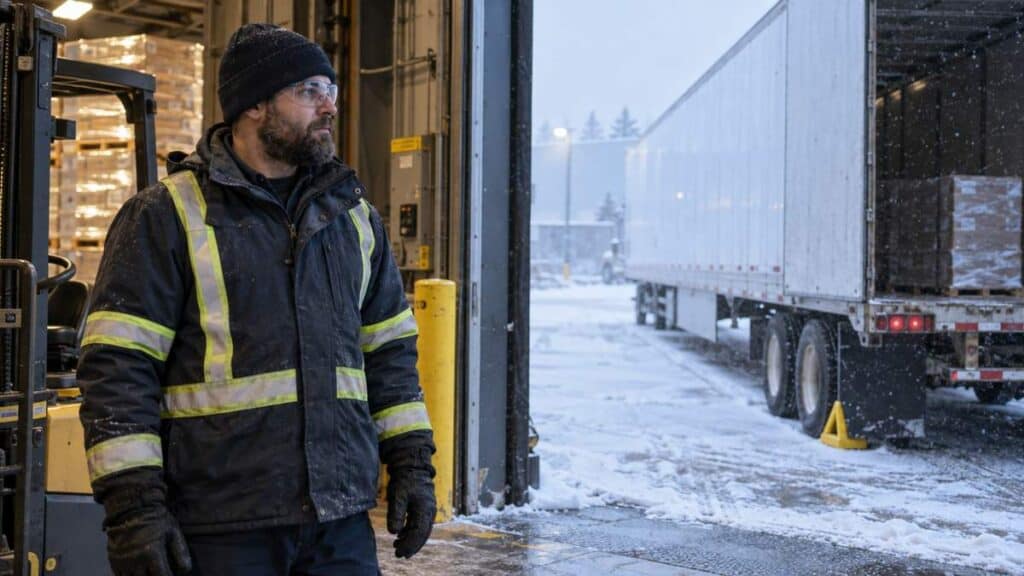
The first frost is here. Overhead doors close. Propane forklifts keep running inside. The yard turns into a skating rink. Winter changes the risks in your plant. Here are the 5 to cover with your teams before the first storm.
Key takeaways
- In extreme cold, the CNESST requires the employer to take preventive measures.
- With doors closed, carbon monoxide can build up. The RSST sets a limit of 35 ppm over 8 hours.
- A short refresher module before the first snow is enough to review the right habits.
In this article
Risk 1: cold at exposed workstations
Think of loading docks, the yard and unheated warehouses. Your employees sometimes spend hours there. The cold becomes a real hazard.
-38 °C
Wind chill
At -23 °C with a 40 km/h wind. Source: CNESST.
10 to 30 min
To freeze
In these conditions, skin exposed to the wind can freeze. Source: CNESST.
< 36 °C
Hypothermia
Body temperature drops below 36 °C. Source: CNESST.
On its Travail au froid page (in French), the CNESST lists several measures. Choose the ones that fit your tasks:
- A heated shelter near outdoor workstations.
- Insulated handles on tools and metal bars.
- Clothing suited to the temperature and the task.
- Warm-up breaks, alternating with work.
- Outdoor tasks during the warmest hours of the day.
Also train your employees to recognize the signs of frostbite and hypothermia. In themselves, and in their coworkers. The CNESST asks workers to watch for these signs.
Risk 2: carbon monoxide behind closed doors
In summer, doors stay open. Air moves. In winter, everything closes to keep the heat in. Meanwhile, propane forklifts keep running. Their engines produce carbon monoxide (CO). It is an invisible, odourless gas.
Exposure limits
No worker may be exposed to a gas beyond the limits in Schedule I.
35 ppm and 175 ppm
For CO: 35 ppm averaged over 8 hours. 175 ppm for short-term exposure.
Ventilation
Establishments must be adequately ventilated.
These rules come from Quebec’s Regulation respecting occupational health and safety (RSST). To meet them in winter:
- Have forklift engines serviced before winter. A poorly tuned engine produces more CO.
- Turn the engine off instead of letting it idle.
- Check ventilation when doors stay closed.
- Measure CO with a detector, especially in enclosed areas.
- Explain the symptoms: headache, nausea, dizziness. An employee who feels them must step outside and report it.
Risk 3: slips on ice
Falls don’t only happen outside. Melting snow comes in on boots. It leaves puddles near the doors. The concrete floor becomes slippery.
Risk 4: forklifts moving between outside and inside
A forklift operator going from the yard into the warehouse changes conditions in seconds. Winter adds traps:
- Braking takes longer on snow, ice and wet concrete.
- Ramps and dock levellers become slippery.
- Snow hides floor markings, holes and obstacles.
- Fog on the overhead guard and on glasses reduces visibility.
- The trailer can move on an icy surface. Check the wheel chocks or the vehicle restraint.
In Quebec, forklift operators must receive theoretical and practical training. The practical part is done under an instructor’s supervision (RSST, s. 256.3). We explain these rules in our article on mandatory forklift training. A winter refresher is a good complement.
Risk 5: roof snow removal
After a big storm, someone is often sent up on the roof. It is work at height, with snow and ice underfoot. The RSST requires workers to be protected against falls of more than 3 metres (s. 33.1).
The CNESST gives a clear order on its Déneiger un toit page (in French):
Clear snow from the ground
With a telescopic roof rake, when possible.
Otherwise, an aerial lift
The worker stays inside the platform and wears a harness at all times.
Going on a flat roof: set it up properly
A warning line creates a 2 m buffer zone along the edge. A guardrail protects the spot where snow is thrown off.
Protect the ground
Mark off the zone where snow and ice fall. Keep everyone out of it. Stay away from power lines.
Winter comes back every year. Winter accidents can be avoided.
Train your teams before the first snow
Quebec’s Act respecting occupational health and safety (s. 51) requires the employer to provide appropriate training and supervision. For winter, you don’t need a long course. Four steps are enough:
List exposed workstations
Docks, yard, cold warehouse, roof, propane forklifts.
Make a 5-minute module
Employees watch it on a tablet or phone. See how to train plant workers without computers.
Post a visual sheet
Near doors and docks. Here is how to create visual work instructions.
Keep the proof
Record who took the refresher, and when. A training record does it for you.
Your pre-winter checklist
- ☐ Heated shelters ready near outdoor workstations
- ☐ Propane forklift engines serviced
- ☐ Ventilation checked with doors closed
- ☐ Snow clearing and abrasive planned before each shift
- ☐ Absorbent mats at entrances
- ☐ Roof snow removal method planned
- ☐ Refresher taken by everyone, proof kept
Frequently asked questions
At what temperature should you act?
The CNESST does not set a single threshold. Cold, wind and moisture all count. Quebec public health notes that cold can affect health as soon as the temperature drops below 5 °C.
Are propane forklifts banned indoors?
No. But ventilation must be adequate. And the air must meet the RSST limits for carbon monoxide.
Can an employee go up on the roof to clear snow?
It is the last resort. The CNESST recommends clearing from the ground first, then using an aerial lift. If there is a risk of falling more than 3 m, the worker must be protected.
Do you need to repeat the training every winter?
No rule requires a yearly cold-weather refresher. But a refresher every fall is good practice. It is short, and it helps new employees.
Want a winter module in your colours, filmed in your plant? Witeach creates short training on your equipment. Training records are ready for the inspector.
