
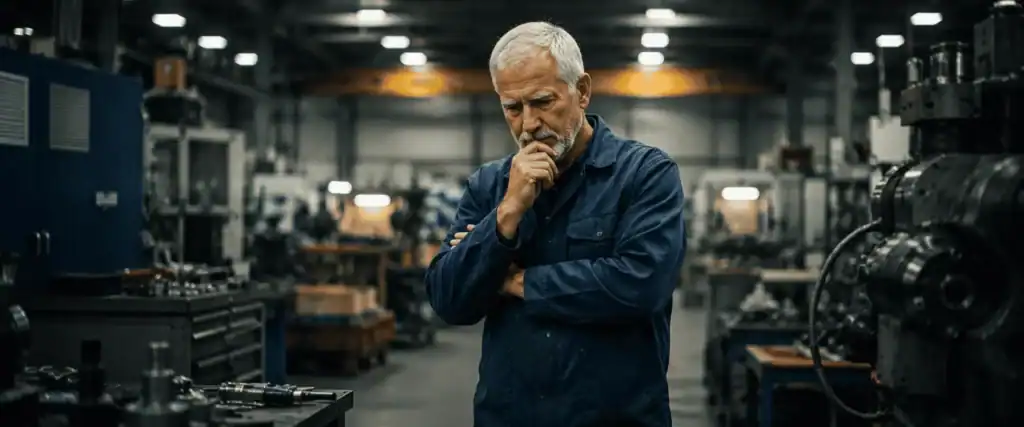
A new welder shows up for your evening shift. He completed a well-produced online course, with slick animations and a quiz at the end. The next day, standing in front of your welding cell, he freezes. The jig is not the one from the video, the emergency stop button is not in the same place, and the purge procedure you require appeared nowhere in the module. He passed his exam, but he does not know how to work in your plant. This is exactly the gap that a custom industrial training fills, the kind that talks about your machines and not machines in general.
Key takeaways
- Generic training provides the regulatory basics; only custom training shows your machines, your words and your procedures.
- Even WHMIS requires a layer adapted to your workplace and your products.
- The right mix: keep generic content where it’s enough, and use custom training for the jobs and equipment specific to your plant.
In this article
- Generic training or custom industrial training: the real difference
- Why your machines, your words and your procedures change everything
- Legally generic does not exempt you from custom
- The real cost of generic: the mistake that repeats
- How to tell whether you need custom training
- The right balance, without breaking the bank
Generic training or custom industrial training: the real difference
Let us be honest: generic training has its place. A well-built WHMIS course, a theory module for forklift operators, a lockout-tagout foundation, all of it provides the shared vocabulary and checks real regulatory boxes. Nobody is going to reinvent the definition of a hazard pictogram for each plant. On that ground, standard content does the job, at a low cost, and it rolls out fast.
The problem begins when you assume that is enough. Generic training explains the world. Custom training explains your world. And on a plant floor, it is your world that injures or produces, not the world in general. The guy who just passed his forklift theory exam knows the theory of the stability triangle. He does not know your too-narrow aisle near shipping, your dock that drops three inches in winter, or the in-house rule that forbids backing up without honking at the packaging department intersection. That knowledge is not something you buy from a catalogue.
What generic training does well
Standard content covers the foundations that transfer from one employer to the next. The basics of health and safety, the regulatory definitions, the principles that do not change from one shop to another. At Witeach, we own this fact instead of hiding it: our WHMIS 2015 (GHS) training at $24.95 and our forklift operator training exist precisely to provide this solid foundation without charging for a custom build to someone who does not need one. We do not sell custom work to a company that is looking for off-the-rack.
What only custom training solves
Where generic training stops, your reality keeps going. Your equipment has its quirks, your internal procedures have a history, and your plant vocabulary was built over thirty years. An employee trained on generic content then has to do the translation alone, in his head, in the middle of production. It is precisely in that improvised translation that errors, breakdowns and near misses are born.
Why your machines, your words and your procedures change everything
Picture something simple. Two workers receive the same instruction: “lock out the energy source before servicing.” The first learned it from a generic animation showing some random electrical panel. The second learned it from a photo of your panel, with your numbered red locks, following your compressed-air purge sequence specific to press number 4. Guess which of the two carries out the right move on the first try, on a Tuesday evening, alone in the department.
When the training shows the exact equipment the employee is going to touch, several things happen at once. Recognition is immediate, there is no mental translation delay. The vocabulary matches: if your team calls a part “the cage” and not “the guard housing,” the training has to say “the cage,” otherwise you create a gap between what is taught and what is said on the floor. And the procedure taught is the real one, not an idealized version that exists in no Quebec plant.
This is not just a matter of teaching comfort. It is a matter of risk. An employee who hesitates in front of a machine hesitates at the worst moment. Training modeled on your reality removes that hesitation, because what he sees on the screen is what he sees in front of him.
Engagement follows relevance
There is a human effect that gets underestimated. When an employee recognizes his own plant in a training course, he understands that the company took the trouble to talk about his specific job. That changes his attitude. Generic content sends an implicit message: “here is what we give everyone.” Custom content sends the opposite: “here is what matters here, for your work.” The supervisor notices it right away in the room, or in the completion rate when the training is online. People tune out in front of the abstract and lock in on the concrete.
Legally generic does not exempt you from custom
Here is the point many managers miss, and it is regulatory. Even for training as “standard” as WHMIS, Quebec law already requires a custom layer. The Regulation respecting information on controlled products, enforced by the CNESST, specifies that the training program must be “adapted to the workers, to the particular features of the workplace and to the nature of the hazardous products” present in your establishment. In other words, the generic module provides the theory of pictograms, but the employer remains required to train on its products, its safety data sheets and its emergency procedures.
That means an employer who settles for a generic WHMIS course and ticks the box is not fully compliant. He is missing the part specific to his plant. Generic is the mandatory starting point, not the finish line. This logic, spelled out in black and white for WHMIS, applies by common sense to nearly all of your operations: real safety and real competence live in the details of your floor.
This same adaptation requirement also applies to mandatory WHMIS training when the time comes to document it for the CNESST. We always come back to the same place: the base content can be standardized, but the application in your plant has to be tailored to your measure.
The real cost of generic: the mistake that repeats
A plant manager quickly works out the price of a training course. He works out less often the price of a training course that does not stick. A poorly prepared employee who breaks a tool, produces a batch of scrap, triggers an unplanned shutdown or injures himself costs infinitely more than the gap between a generic module and content designed for your equipment. This is where custom industrial training stops being a comfort expense and becomes a management calculation. The mistake that comes back every time a new hire arrives, that is the real money pit.
There is also the matter of knowledge walking out the door at retirement. When your 58-year-old maintenance guy, the one who knows the quirks of every machine, leaves the plant, his knowledge goes with him if no one has captured it. Generic training will never replace him, because it contains nothing of what he knew. This is where mapping your critical knowledge and training built on your ways of working become an insurance policy against collective forgetting.
And this expense is not wasted. For a company whose payroll exceeds two million dollars, training investment counts toward Quebec’s 1% training law, administered by the Commission des partenaires du marché du travail. So the money you put into training your people on your equipment works twice: it reduces your errors and it counts toward a legal obligation you have to meet anyway.
How to tell whether you need custom training
The question is not “generic or custom,” as if it were one or the other. The two live side by side. The right question is: where does the useful generic end and the necessary custom begin in your plant? A few signs do not lie.
- Your new employees take a training course, pass the quiz, then still ask the same basic questions once they are on the floor.
- You have equipment, jigs or procedures that no external course could ever show, because they exist only in your plant.
- Part of your knowledge rests on a few key people, and you have nothing written or filmed if they leave.
- Production errors or incidents cluster on recently filled positions or on the less-supervised shifts.
If you recognize yourself in even one of these points, generic content alone does not protect you. You need the layer that speaks about your machines, in your words, in the order your people actually work.
The right balance, without breaking the bank
Good news: custom industrial training does not mean redoing everything from scratch. A well-supported company keeps the generic where it is enough, the regulatory base, the theoretical foundations, and focuses the customization effort where it pays off: the critical positions, the dangerous or expensive equipment, the in-house procedures. It is that smart balance that delivers compliance, retention and return on investment all at once.
The result, on the floor, shows up in concrete things. A new hire who is up to speed faster. A supervisor who repeats the same instructions less often. Less scrap in the first week. An employee who, standing at his machine on a Tuesday evening, knows what to do because he has seen it before, the real one, not a generic version. That is the difference between training people in general and training your people.
📚 Read next
Not sure what should stay generic and what deserves custom work in your plant? Start with our free self-assessment, or talk directly about your equipment and your procedures with our team through the Services page or by reaching us on the contact page. We look at your reality before proposing anything at all.
